
CNC Routing and Cutting of Dibond: Precision, Clean Edges and Custom Fabrication
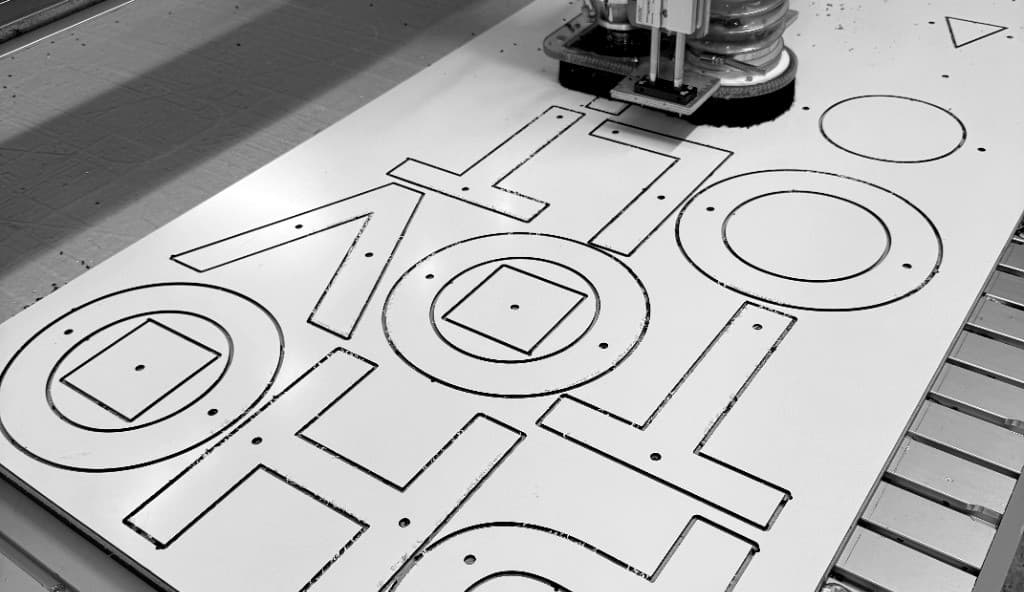
Aluminium composite material (ACM), commonly known under brand names such as Dibond, Alupanel, or Reynobond, is one of the most widely used substrates for signage, retail fit-outs, and technical paneling. Consisting of two thin aluminium skins thermally bonded to a high-density black polyethylene core, it delivers outstanding stiffness and flatness at a fraction of the weight of solid aluminium.
To achieve razor-sharp edges without distorting the skins or marring the lacquered surface, 3-axis CNC router machining on a high-flow vacuum bed is the industrial standard for accuracy and repeatability.
Why Machine Dibond on a CNC Router?
Manual cutting or circular saws quickly show their limits on freeform shapes or visual pieces: scratches on prepainted finishes, aluminium burrs on cut lines, and inconsistent tolerances on fine features.
Machining with a dedicated 3-axis CNC router provides clear technical advantages:
- Burr-free, clean edges: Using specialized single-flute solid carbide spiral endmills designed for aluminium avoids overheating the polyethylene core while cutting both aluminium skins cleanly.
- Vacuum table hold-down: High-volume vacuum clamping secures panels flat against the spoilboard, eliminating vibration and chatter even on narrow profiles or nested lettering.
- Tight dimensional tolerances: Precision within a tenth of a millimeter, essential for parts designed to be mounted on frames, bolted, or folded into architectural assemblies.
Operations Performed at Our Workshop
Beyond straight panel sizing, our CNC center carries out all processing operations needed by sign makers, agenciers, and engineering teams:
- Profiling and freeform contours: Custom sign lettering, vectorized company logos, architectural fretwork, and tailored cutouts.
- Drilling and countersinking: Mounting holes, countersunk holes for flush screw heads, tapping, and cable passthroughs.
- V-Grooving for tray folding (cassette fabrication): Routing a 90° or 135° V-groove on the rear face while leaving the outer aluminium sheet and approximately 0.8 mm of the core intact. This enables clean manual folding to form seamless 3D trays, lightboxes, totems, and column claddings without cracking the paint.
Typical Applications
- Signage & Visual Communication: Exterior shop fascias, 3D cut letters, corporate directory boards, and weatherproof wayfinding panels.
- Commercial Fit-Outs & Events: Lightweight exhibition booths, retail backdrops, reception desk claddings, and durable interior displays.
- Industrial & Architectural Paneling: Machine guard panels, technical access hatches, soffits, and ventilated facade cassettes.
Technical Specifications and Accepted File Formats
- Machinable thicknesses: 2 mm, 3 mm, 4 mm, and 6 mm (skin thickness 0.2 mm or 0.3 mm).
- Surface finishes: Matte or gloss white, deep black, standard RAL colors, brushed aluminium, mirror finish, or mill finish.
- Accepted CAD file formats: 1:1 vector drawings in DXF, DWG, vectorized AI (Illustrator), vector PDF, or STEP.
Frequently Asked Questions
What are the cutting tolerances for Dibond on CNC?
On our industrial vacuum CNC table, tolerances typically hold within plus or minus 0.1 to 0.2 mm, ensuring a precise fit on mounting substructures and brackets.
What is the difference between laser cutting and CNC routing for Dibond?
Standard laser cutting tends to melt and burn the polyethylene core, creating toxic fumes and recessed, scorched edges. Mechanical CNC milling cuts the material cold with high-speed chips, leaving a clean, straight, and stable edge.
Can you supply the raw panels?
Yes. We can source composite sheets according to your color, core, and thickness requirements, or machine sheets supplied directly by your team.
What is the typical lead time for a production batch?
Prototypes and one-off pieces are usually machined within 48 to 72 hours following vector file validation. For larger production runs, lead times are scheduled upon quote confirmation.
Besoin d'un partenaire d'usinage CNC grand format ?
Notre atelier à Toulouse et Lombez transforme vos fichiers 2D/3D en pièces usinées avec devis garanti sous 48h.
Découvrir notre service d'usinage CNC Toulouse →Need a Similar Technical Part?
Our workshop in Toulouse shapes your prototypes and medium-series wooden and composite parts with the same rigorous industrial precision.