
The Profitable Flat-Pack Guide: Outsourcing Production for Your E-commerce Brand
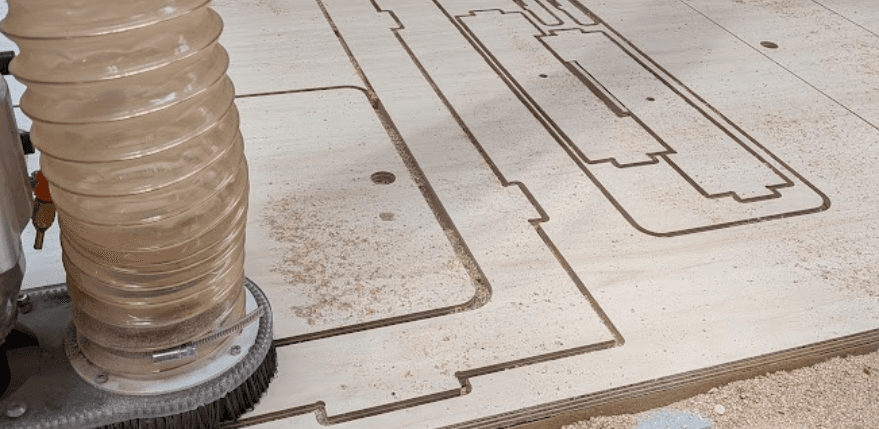
Do you sell furniture, van-life accessories, climbing training equipment, or any other physical direct-to-consumer (D2C) product? You already know it: what you pay the carrier can destroy your margin before you even factor in manufacturing costs. At Alcyde, we machine daily for e-commerce brands that have adopted a simple rule: the most profitable product isn't the cheapest to make — it's the cheapest to ship.
This guide explains how designing for "Flat-Pack" from the engineering stage, combined with large-format flat CNC machining (1250x2500mm) and high-density Nesting, can dramatically cut your shipping costs — up to 60% on some SKUs — while securing your series production.
1. The real hidden cost of bulky e-commerce products
1.1 The dimensional overcost nobody budgets for at launch
Most brand creators calculate their cost price based on material and machining time. They overlook a third line item, often heavier than the first two combined: the carrier billing threshold. A box exceeding a size threshold by just a few centimeters (length + width + height, or "volumetric weight") can push a package into a pricing tier two to three times more expensive.
For a factory-assembled product (an assembled piece of furniture, a rigid structure), this is almost systematic. The result: shipping costs eating 20 to 40% of your sale price, and a degraded customer experience due to longer lead times from special carriers.
1.2 Thinking Flat-Pack from the very first sketch
The solution isn't found in negotiating with the carrier, but upstream, in product design. A "Flat-Pack" product is designed to be shipped flat, in optimized separate parts, easily assembled by the end customer (mortise-and-tenon systems, eccentrics, dowels). This is exactly the logic we apply at Alcyde when supporting e-commerce brands like Inoko, one of our major B2B clients for whom we series-machine modular van fit-out kits: every part is designed to fit into a standard shipping template, without ever sacrificing rigidity or the aesthetics of the finished product.
2. How Alcyde turns your product into a cash-flow machine
2.1 Large-format flat CNC machining 1250x2500mm: the foundation of everything
Our CNC machining workshop in Toulouse is equipped with a large-format flat CNC machining line (1250x2500mm) with automatic tool change. This capability lets us machine all of your parts on a standard panel, with no manual rework step, respecting strict tolerances that guarantee perfect assembly by your customers — often without instructions or special tools.
2.2 High-density Nesting: optimizing every panel
Before the machine even starts, our design office calculates the placement of all your parts on the raw panel using high-density Nesting algorithms. This algorithmic nesting maximizes the number of parts produced per panel, reduces your unit material cost, and above all limits the number of different references to manage in stock — a real cash-flow win on your first orders.
2.3 Flat-Pack packaging optimized for standard shipping
This is the financial heart of the matter: we design Flat-Pack packaging optimized for standard shipping, meaning calibrated to fit within standard carrier network templates (regular parcels, no "oversize" surcharge), rather than expensive special freight channels. Concretely, this means:
- Custom-fit boxes protecting the edges and corners of machined parts during transport.
- Controlled weight thanks to lightweight yet resistant technical materials (poplar plywood, birch, lightened MDF).
- Grouped palletization for volume restocks, when a single parcel is no longer the right logistics unit.
2.4 Digital continuity from the design office to CAM
Every design iteration (a tenon that's too tight, an assembly clearance to adjust) is directly reflected in the production file thanks to digital continuity from the design office to CAM: your 3D files (STEP) are imported, corrected, then reprogrammed into G-Code with no manual re-entry. No information is lost between your idea and the machined part.
3. DIY vs Subcontracting to Alcyde: the numbers comparison
| Criteria | In-house manufacturing (small machine fleet) | Alcyde Subcontracting |
|---|---|---|
| Machine investment | €30,000 to €150,000 + training | €0 (invoiced per part or panel) |
| Material optimization (Nesting) | Manual, often approximate | Algorithmic, high-density |
| Assembly tolerances | Variable by operator | Strict, repeatable in series |
| Ramping up production | Limited by machine fleet | Absorbed by automatic tool change |
| Logistics packaging | To design from scratch | Proven Flat-Pack expertise |
| First pilot batch lead time | Weeks (machine setup) | 48h for a quote, fast production |
4. Our 5-step production process
- Receiving your 3D files (STEP, DXF) and auditing the design for Flat-Pack compatibility.
- Nesting: calculating the optimal layout on standard panels to reduce waste.
- Large-format flat CNC machining: cutting, drilling, milling in a single pass.
- Quality control and finishing: deburring, sanding, dimensional control according to your strict tolerances.
- Packaging and shipping: boxed or palletized, ready for pickup by your carrier.
5. After-sales management: zero bad surprises
A poorly designed Flat-Pack product generates costly after-sales issues (broken parts, failed assembly, customer returns). By locking in tolerances and repeatability from the machining stage, we drastically limit this risk. If needed, our workshop can relaunch a single replacement part without restarting an entire series — an asset for responsive, well-managed after-sales support.
Frequently Asked Questions
What's the minimum volume to subcontract with Alcyde? We work on pilot series (a few dozen kits to validate your market) as well as recurring industrial volumes.
Can I evolve my design after the first batch? Yes, it's even recommended: our file iterations go directly through our design office, with no need to start from scratch.
Do you only work with wood? No, we also machine technical plastics (HDPE) and composites (Dibond, HPL) depending on your product's mechanical requirements.
Got an e-commerce product ready to take off? Get a quote within 48h by sending your DXF/STEP files or contact our design office.
Request a Manufacturing Quote | Explore Our Toulouse CNC Machining Workshop | View the INOKO Case Study
Vous êtes menuisier ou agenceur en Occitanie ?
Découvrez comment nous sous-traitons la découpe nesting de caissons, cuisines et dressings avec étiquetage unitaire.
Découvrir la sous-traitance menuiserie & agencement →Need a Similar Technical Part?
Our workshop in Toulouse shapes your prototypes and medium-series wooden and composite parts with the same rigorous industrial precision.