
The Complete Guide to CNC Nesting: How to Cut Your Material Costs by 15 to 30%
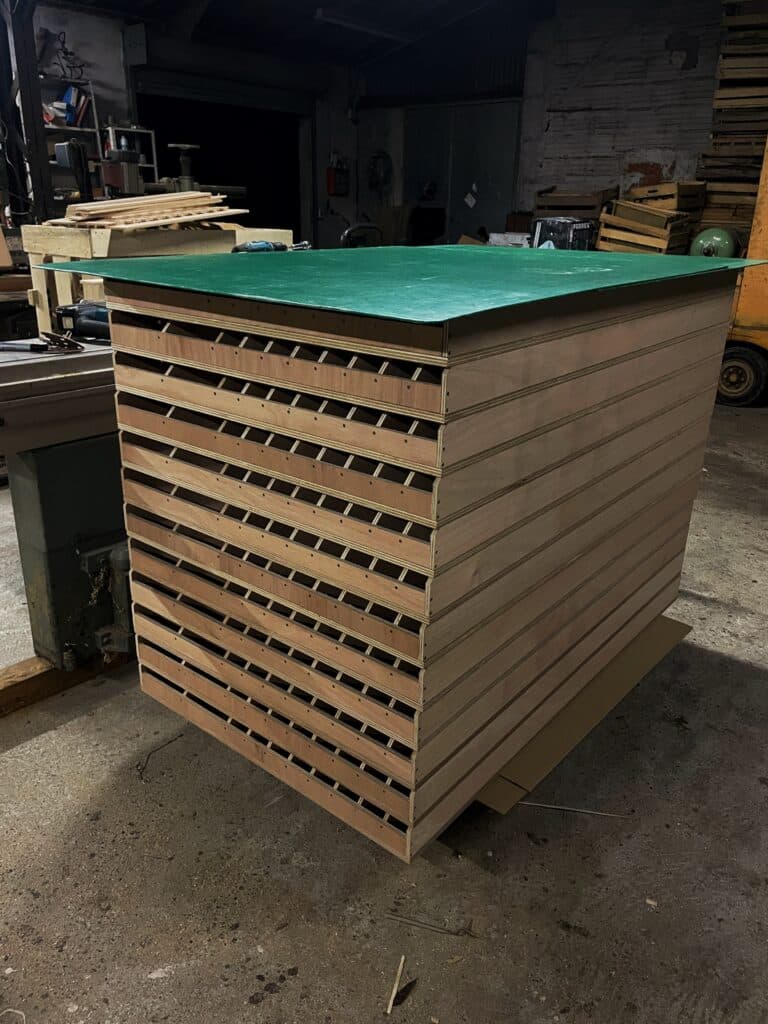
For an industrial client, an architect or a fitter, raw material (plywood, MDF, technical plastics, composites) is often the single largest cost item in a machining project — well ahead of labor or machine depreciation. Nesting is the technical answer to this economic equation: an optimization method that can cut your material costs by 15 to 30%, while speeding up order execution. This guide explains the process in detail, its measurable benefits, and why it's a decisive selection criterion when choosing your CNC subcontractor.
1. What is CNC Nesting?
1.1 Technical definition
Nesting is a flat CNC cutting process in which all the parts of an order are virtually arranged on the same raw panel so as to occupy the available space with minimal waste. Unlike traditional part-by-part cutting, Nesting treats an entire standard panel (typically 2500x1220mm, but our equipment can handle large-format flat CNC machining up to 1250x2500mm) as a single optimized production plan.
1.2 The algorithm behind the layout
Calculating the optimal placement of parts on a panel is a mathematical problem known as "bin packing." Our CAM software runs high-density Nesting algorithms that test thousands of rotation and positioning configurations for each part, in order to minimize scrap area — the familiar "confetti" of unused panel left over after traditional cutting.
2. Why Nesting cuts your costs by 15 to 30%
2.1 Direct reduction of material waste
With manual or poorly optimized cutting, the average waste rate in the panel industry is often between 25 and 40%. With well-tuned high-density Nesting, this rate can drop below 10%. On a project consuming dozens of panels per month, this gap translates directly into euros saved on your material invoice — with no compromise on the quality of the parts produced.
2.2 Pooling machining across multiple orders
Beyond a single order, Nesting allows you to pool machining operations for multiple references on the same panel, or even for multiple clients on the same production batch (while respecting file confidentiality). This pooling reduces the number of panels needlessly started and optimizes machine time — a benefit we pass directly onto our subcontracting rates.
2.3 Faster execution compared to traditional methods
Traditional cutting (panel saw, manual cutting) requires multiple reworks, manual tool changes and heavy handling between each step. Our large-format flat CNC machining line, fitted with automatic tool change, executes the entire Nesting plan in a single machine cycle: cutting, drilling, milling and grooving are all carried out in one go, with no rework. The result: production lead times cut by two to three compared to a traditional workshop.
3. The environmental impact of Nesting: less waste, smaller footprint
Reducing material waste isn't just a financial argument — it's a real environmental lever. Consuming fewer panels means:
- Less wood or technical plastic extracted, processed and transported for the same volume of parts delivered.
- Less industrial waste to treat or recycle at the end of production.
- A reduced logistics carbon footprint, with fewer trucks needed to supply raw material.
For companies engaged in CSR initiatives or bound by environmental specifications (public tenders, aerospace supply chains, large industrial accounts), high-density Nesting is a factual, measurable argument to include in your supplier reporting.
4. Traditional Nesting vs High-Density Nesting at Alcyde
| Criteria | Traditional cutting | High-density Nesting (Alcyde) |
|---|---|---|
| Average waste rate | 25 to 40% | Below 10% |
| Preparation time | Manual tracing, plan by plan | Automated algorithmic calculation |
| Repeatability | Variable by operator | Identical for every panel |
| Tolerances | Approximate (mm) | Strict tolerances (tenth of a mm) |
| Tool change | Manual, machine stop | Automatic, no interruption |
| Material/environmental impact | Significant waste | Significant waste reduction |
5. How a Nesting project runs at Alcyde
- Receiving your plans: DXF, DWG or STEP files sent to our design office.
- Analysis and digital continuity from the design office to CAM: your native files are used directly with no re-entry, guaranteeing total fidelity between your design and the machined part.
- Nesting plan calculation: our algorithms compute the optimal layout on available standard panels.
- Large-format flat CNC machining (1250x2500mm): executing the plan in a single machine cycle in our Toulouse workshop, with automatic tool change and high-power vacuum bed.
- Quality control: dimensional verification against your strict tolerances before packaging.
Frequently Asked Questions on CNC Nesting
Does Nesting work with all materials? Yes: plywood (birch, poplar, okoume), MDF, composite panels (Dibond, HPL), and technical plastics (HDPE, PMMA) can all be processed with Nesting on our machining line.
Is Nesting suitable for small series? Absolutely. Nesting is relevant as soon as a panel contains several parts, even for a prototype or small series — the material savings remain proportional.
Can I mix several different references on the same panel? Yes, this is even one of the main savings levers: we pool your different parts (and sometimes your different orders) to maximize material yield.
What's the difference between Nesting and laser cutting? Nesting is a layout optimization method, independent of the cutting technology. At Alcyde, this plan is executed via flat CNC machining (routing), better suited to thick wood and composite panels than laser cutting.
Ready to cut your material cost on your next order? Get a quote within 48h by sending your DXF/STEP files or contact our design office.
Request a Nesting Optimization Study | Explore Our Toulouse CNC Machining Workshop | Custom Cutting for Carpenters
Besoin d'un partenaire d'usinage CNC grand format ?
Notre atelier à Toulouse et Lombez transforme vos fichiers 2D/3D en pièces usinées avec devis garanti sous 48h.
Découvrir notre service d'usinage CNC Toulouse →Need a Similar Technical Part?
Our workshop in Toulouse shapes your prototypes and medium-series wooden and composite parts with the same rigorous industrial precision.