
Circular Economy and CNC Machining: The Challenge of Reused Trespa
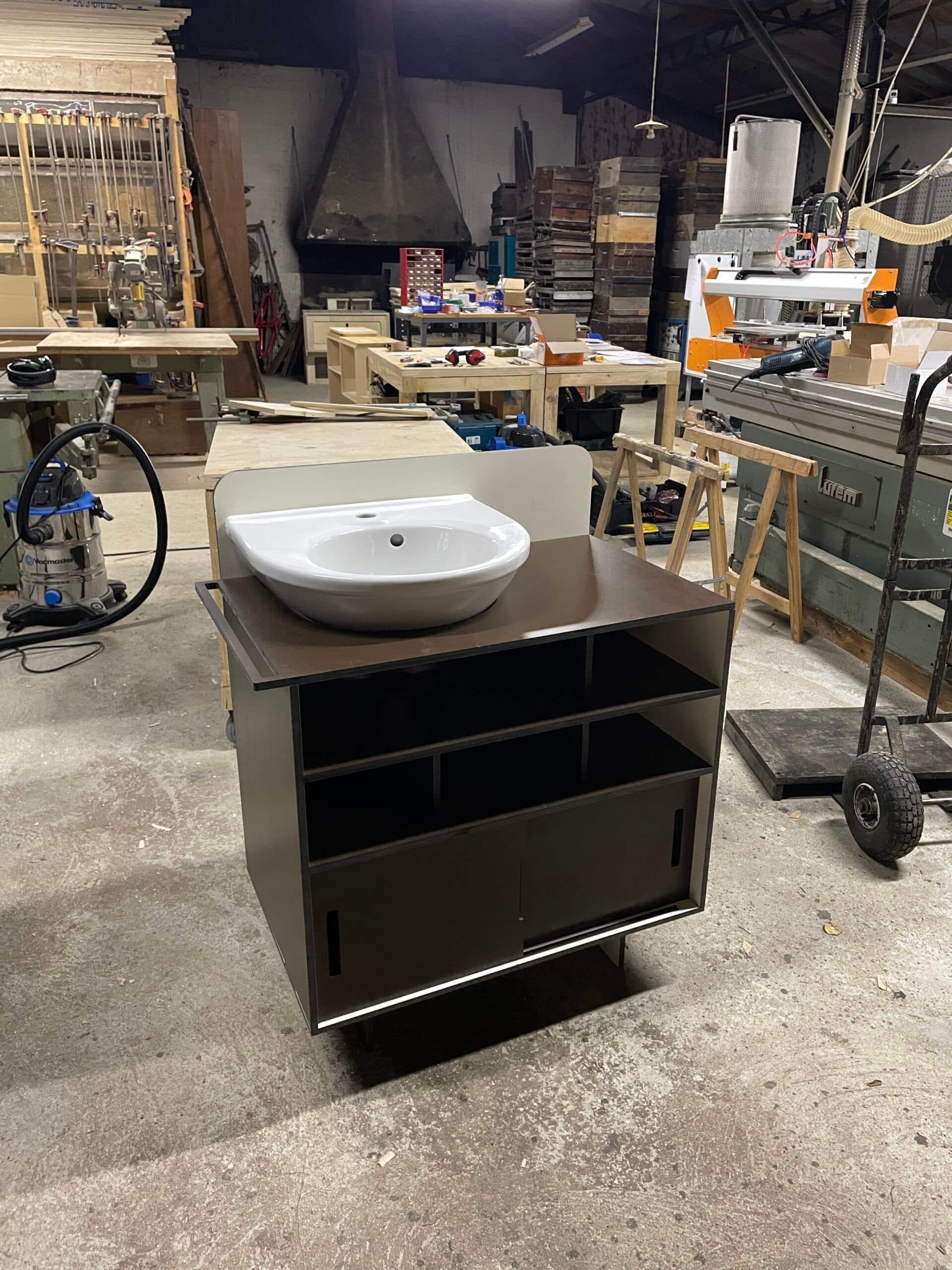
Sector: Building, Student Residence, Circular Economy Alcyde Expertise: Design Office (Design for Manufacturing), CNC HPL Machining, Series production Material: 100% Recycled Trespa (HPL) Challenge: Industrialize the design of a reused material for a large series
The circular economy and the reuse of materials have become major issues in the construction sector. Recently, Alcyde had the opportunity to put its machining expertise at the service of a bold student residence project, focused on industrial upcycling.
The Project: From Nursing Home to Student Housing
The client's concept was strong: to build a new student residence by reusing a maximum of "waste" from the deconstruction of the old building (a nursing home) present on the site.
Among the recovered materials were old sanitary partitions in Trespa (High-Pressure Laminate – HPL). This material, renowned for its extreme hardness, rot resistance, and water resistance, was the ideal candidate to be transformed into vanity units for the new student bathrooms.
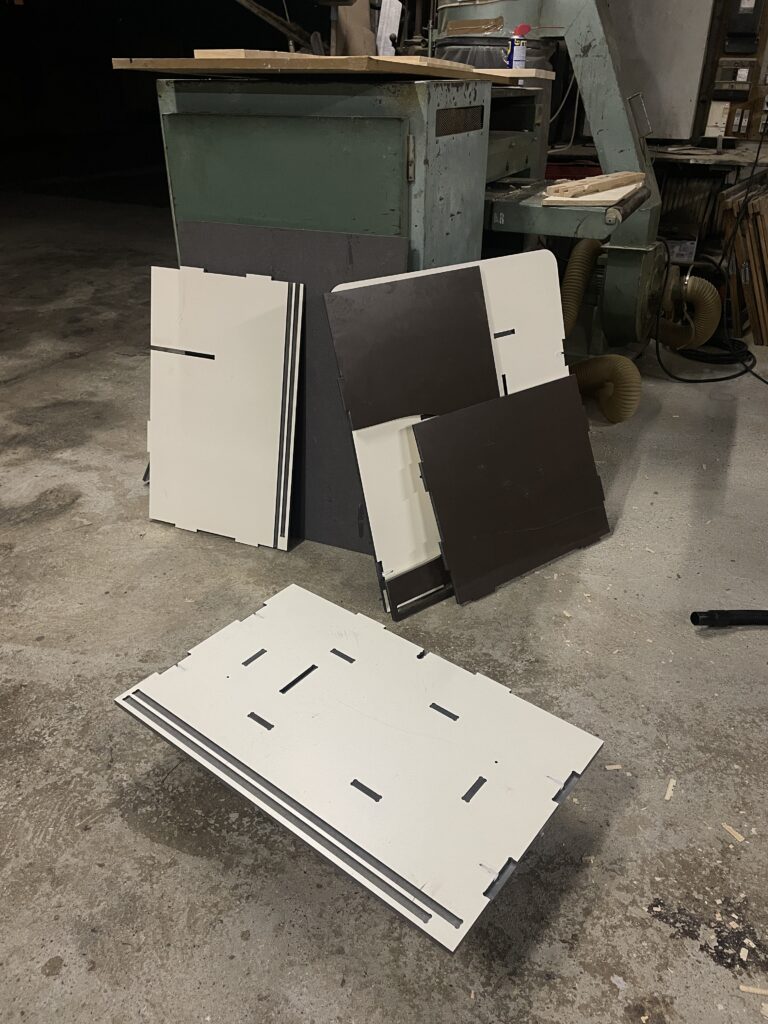
The Challenge: Adapting the Designer's Idea to Industrial Reality
A designer had imagined the lines and volumes of these new vanity units from the reused Trespa panels. However, imagining a unique piece is one thing; producing it in a large series is another.
This is where Alcyde's design office comes in. Our mission was to bridge the gap between the designer's aesthetic vision and the constraints of series CNC machining. Trespa is a particularly dense material, which quickly wears out cutting tools and forgives few assembly errors.
"Design for Manufacturing": The Alcyde Touch
To make this upcycling project economically and technically viable, we had to adapt the initial design:
Assembly optimization: We rethought the junctions imagined by the designer to create specific interlocks (CNC machined). This eliminated unnecessary hardware and drastically reduced assembly time in the workshop.
Cutting standardization: Since the recovered panels had varying dimensions, our Nesting software had to be configured to adapt to non-standard formats, while maximizing the yield of each panel saved from the dumpster.
High Performance Machining: Cutting and drilling Trespa requires specific diamond tools and feed rates calculated to avoid any splintering on the edges, guaranteeing an impeccable finish for future students.
The Circular Economy on an Industrial Scale
Thanks to this preliminary engineering phase, we were able to launch the series production of these vanity units. This project proves that the environmental approach of upcycling is not incompatible with industrial production rates, provided that machining constraints are integrated right from the design stage.
Are you an architect, designer, or developer and want to industrialize the manufacture of furniture from reuse? Contact the Alcyde design office to study the technical feasibility of your project.
Besoin d'usinage de plastiques techniques ou de composites ?
Consultez nos capacités de fraisage de précision sur PEHD 500/1000, POM-C, PMMA, HPL Compact et Dibond.
Découvrir nos capacités plastiques & composites →Need a Similar Technical Part?
Our workshop in Toulouse shapes your prototypes and medium-series wooden and composite parts with the same rigorous industrial precision.